
Online conversations are full of short forms, abbreviations, and slang. One abbreviation that can confuse readers is IDE. Unlike common texting terms such as IDK or TBH, IDE can have different meanings depending on the conversation.
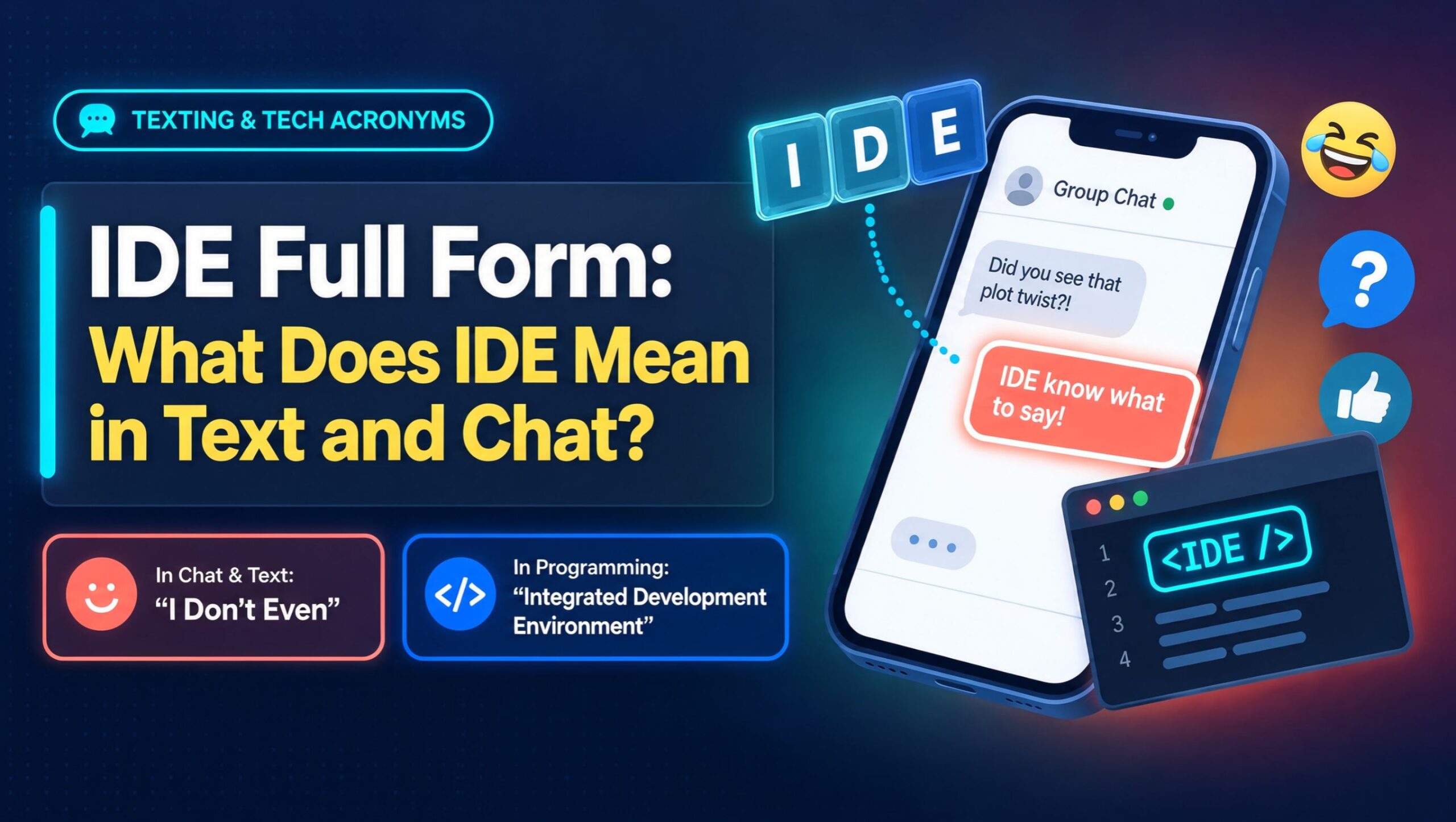
In many casual text conversations, IDE is used as a shortened form of “I don’t even”, usually before another word or phrase. For example, someone may write, “IDE know what happened,” intending a very informal version of “I don’t even know what happened.” However, usage can vary, and context matters.
This guide explains the IDE meaning in text slang, where it comes from, how people use it on social media, and how to respond when you see it. It also compares IDE with similar internet abbreviations so you can understand the difference quickly.
IDE Meaning in Text Slang – Quick Meaning
In casual texting, IDE can mean “I don’t even.” It is normally used to express confusion, disbelief, frustration, surprise, or a strong emotional reaction.
For example, a person might say, “IDE understand why he left.” The intended meaning is “I don’t even understand why he left.” The abbreviation makes the sentence shorter and gives it an informal internet-chat style.
IDE is not as standardized as some popular abbreviations. Some people may use it differently, while others may interpret it as a typo or another abbreviation. Therefore, the words around IDE are important.
| Slang | Common meaning | Typical use |
| IDE | I don’t even | Confusion, disbelief, frustration |
| IDK | I don’t know | Uncertainty |
| IDC | I don’t care | Indifference |
| TBH | To be honest | Honest opinion |
| SMH | Shaking my head | Disappointment or disbelief |
Simple examples
Here are a few simple examples of how IDE may appear in casual messages:
- “IDE know what to say.”
- “IDE understand this situation.”
- “IDE believe you actually did that.”
- “IDE remember his name.”
- “IDE want to argue anymore.”
The meaning becomes clearer when the surrounding sentence is considered. If someone sends only “IDE,” it can be difficult to know exactly what they mean.
Origin & Background of IDE in Slang
IDE developed within the broader culture of internet shorthand. People have used shortened expressions for years to make online conversations faster and more casual.
Texting created an environment where users often removed unnecessary words, vowels, or spaces. Social media then made these shortcuts even more common. Platforms with quick replies and character limits helped popularize short expressions.
Unlike older abbreviations such as LOL and ASAP, IDE does not have one universally accepted definition. Its meaning depends heavily on the community and sentence in which it appears.
Why abbreviations became popular
There are several reasons people use abbreviations in digital conversations:
- They save typing time.
- They make messages feel more casual.
- They fit fast-moving conversations.
- They can communicate emotion quickly.
- They create a shared online language.
- They can make a message sound more conversational.
Teenagers and young adults often experiment with new forms of online slang. Some abbreviations become widely recognized, while others remain limited to certain groups.
Real-Life Conversations Using IDE
The best way to understand slang is to see it in context. IDE can appear differently depending on the platform and relationship between the people talking.
1. WhatsApp Chat
Alex: Are you coming to the party tonight?
Sam: IDE know yet. My parents might need me at home.
Here, IDE expresses uncertainty and means something similar to “I don’t even know yet.”
Another example:
Alex: Why did Mike leave so early?
Sam: IDE understand him anymore.
The abbreviation keeps the conversation short and informal.
2. Instagram DM Conversation
Mia: Did you see her new post?
Lena: Yes 😭 IDE know what to think.
The emoji adds emotional context. In this situation, IDE contributes to a casual and expressive tone.
Instagram conversations often combine abbreviations with emojis, punctuation, and reaction words. The result can be much less formal than traditional written English.
3. TikTok Comment Section
A TikTok comment might say:
“IDE understand how this has 2 million views.”
The commenter is expressing surprise or disbelief. The abbreviation makes the comment feel quick and conversational.
Another person might write:
“IDE believe people still do this.”
The exact emotion depends on the video and surrounding comments.
4. Text Message Example
Friend 1: Did you finish the assignment?
Friend 2: IDE even start it 😭
The sentence communicates that the person has not started the assignment at all. The abbreviation also gives the message a relaxed tone.
Emotional & Psychological Meaning
Text slang is not only about saving time. Abbreviations can also communicate emotion. IDE often appears when someone feels confused, overwhelmed, surprised, annoyed, or doubtful.
The emotional meaning depends on the words that follow it. “IDE know” can sound confused. “IDE believe this” can sound shocked. “IDE care anymore” can sound emotionally tired or frustrated.
This is why reading an abbreviation alone can be misleading. Digital communication lacks many face-to-face signals, such as facial expressions and voice tone.
Why people relate to it
People often use informal language because it feels natural and emotionally direct. A short expression can sound more spontaneous than a carefully written sentence.
IDE can also create a sense of familiarity between friends. When both people understand the shorthand, communication becomes faster and more relaxed.
However, slang should not automatically be interpreted as negative. The emotional meaning comes from the full message.
Usage in Different Contexts
IDE is mainly associated with informal digital communication. Its appropriateness changes depending on the platform and relationship.
1. Social Media
Social media is one of the most natural places to encounter slang like IDE. Comments, captions, replies, and direct messages often favor short and expressive language.
Users may combine IDE with emojis, GIF references, hashtags, or other abbreviations. The goal is usually speed and personality rather than formal grammar.
2. Friends & Relationships
Friends frequently use abbreviations because they already understand each other’s communication style.
A message such as “IDE know what happened” may sound perfectly normal between close friends. In a serious conversation, however, writing the complete phrase may make the message clearer.
3. Work or Professional Settings
IDE is generally better avoided in professional communication unless the workplace has an extremely informal communication culture.
For emails, business reports, applications, client messages, and official documents, complete sentences are safer. Writing “I don’t even understand” is clearer and more professional than using an unfamiliar abbreviation.
4. Casual vs Serious Tone
| Situation | IDE appropriate? | Better choice |
| Close friends | Yes | IDE |
| Casual group chat | Usually | IDE |
| Social media comments | Usually | IDE |
| New acquaintance | Maybe | Full phrase |
| Workplace chat | Usually no | Full phrase |
| Formal email | No | Full phrase |
| Academic writing | No | Standard English |
Common Misunderstandings
Because IDE is less standardized than some texting abbreviations, misunderstandings are possible.
Misunderstanding 1: Thinking it’s a typo
Some readers may assume IDE was typed accidentally. This is especially likely when the abbreviation appears without context.
If the sentence does not make sense, politely asking what the person means is better than guessing.
Misunderstanding 2: Confusing it with technical terms
IDE is also a well-known technical abbreviation for Integrated Development Environment in software development.
For example, programmers use IDE when discussing applications such as coding environments. Therefore, the surrounding context is extremely important.
If someone says, “Which IDE do you use for Python?” they are almost certainly discussing programming, not texting slang.
Misunderstanding 3: Using it too formally
Another problem occurs when people assume every abbreviation is suitable everywhere.
IDE may work in a casual chat, but it can look unclear or unprofessional in formal writing. When the audience is unfamiliar with the slang, spelling out the phrase is usually better.
Comparison Table
| Expression | Meaning | Tone | Common context |
| IDE | I don’t even | Informal | Texting and social media |
| IDK | I don’t know | Informal | Everyday chats |
| IDC | I don’t care | Informal | Opinions and reactions |
| TBH | To be honest | Casual | Social media and chats |
| SMH | Shaking my head | Casual | Disbelief or disappointment |
| FWIW | For what it’s worth | Casual | Opinions and advice |
| IDK | I don’t know | Very common | Texting |
| IYKYK | If you know, you know | Internet slang | Shared experiences |
Variations and Related Expressions
IDE belongs to a wider group of internet abbreviations. Learning related terms can help you understand digital conversations more easily.
1. IDEK
IDEK commonly means “I don’t even know.” It adds “know” to the shortened expression and is often used to show uncertainty or confusion.
2. IDTS
IDTS generally means “I don’t think so.” People use it when disagreeing or expressing doubt.
3. SMH
SMH means “shaking my head.” It commonly expresses disappointment, disbelief, annoyance, or mild criticism.
4. ICYMI
ICYMI means “in case you missed it.” It is frequently used when sharing news, posts, videos, or information.
5. TBH
TBH means “to be honest.” It introduces an honest opinion or personal reaction.
6. FWIW
FWIW means “for what it’s worth.” It is often used before giving an opinion, suggestion, or additional information.
7. IDK
IDK means “I don’t know.” It is one of the most common abbreviations in digital communication.
8. IDC
IDC means “I don’t care.” Depending on context, it can sound neutral, dismissive, annoyed, or playful.
9. IYKYK
IYKYK means “if you know, you know.” It is commonly used for shared experiences, inside jokes, or information understood by a particular group.
10. SMFH
SMFH is a stronger variation of SMH and is generally used to express intense frustration or disbelief. Because it can contain profanity in its expanded form, it is best kept to very informal settings.
How to Respond When Someone Uses IDE
Your response should match the tone of the original message. If a friend uses IDE casually, there is usually no need to respond formally.
Casual Replies
You can respond naturally with:
- “Same.”
- “I know right?”
- “Honestly, me neither.”
- “I get what you mean.”
- “Yeah, that’s confusing.”
Funny Replies
If the conversation is playful, humor can work well:
- “Welcome to the club 😂”
- “Neither do I.”
- “We need answers ASAP.”
- “At this point, nobody knows.”
Mature or Supportive Replies
If the person sounds frustrated, a supportive response is better:
- “I understand why you’re confused.”
- “Take your time. You don’t have to figure it out right now.”
- “Want to talk about what happened?”
Private or Respectful Replies
For sensitive conversations, avoid jokes or excessive slang. A calm response can prevent further misunderstanding.
For example, “I understand. If you want to explain what happened, I’m listening” is clearer and more respectful.
Regional & Cultural Usage
Internet slang can cross borders very quickly. However, its familiarity can vary between regions, age groups, and online communities.
Western Culture
In the United States, Canada, the United Kingdom, and other English-speaking online communities, abbreviations are common in casual digital communication.
However, IDE is not necessarily as universally recognized as IDK, LOL, or TBH. Context remains important.
Asian Culture
Many English-speaking internet users in Asian countries also use English abbreviations while chatting online. These expressions may appear alongside local languages and transliterated phrases.
Usage often depends on age, education, platform, and familiarity with English internet culture.
Middle Eastern Culture
English abbreviations are also common among many internet users in Middle Eastern online communities, particularly where English is frequently used alongside Arabic.
The same abbreviation can appear in mixed-language conversations. Its meaning still depends on context.
Global Internet Usage
Social media has made slang increasingly international. A person can encounter an abbreviation created in one online community and see it used thousands of miles away.
Still, not every abbreviation becomes globally standardized. IDE is a good example of why context should always be considered.
FAQs About IDE in Text Slang
What does IDE mean in texting?
IDE can mean “I don’t even” in casual texting, usually as part of a longer phrase such as “IDE know.”
Is IDE the same as IDK?
No. IDK means “I don’t know,” while IDE can mean “I don’t even” when used as slang.
Is IDE rude?
IDE itself is not inherently rude. Its tone depends on the sentence, situation, and relationship between the people communicating.
Can IDE be used in professional messages?
It is usually better to avoid IDE in formal or professional communication because not every reader will understand the slang.
Why do people use IDE instead of full sentences?
People use abbreviations because they are quick, casual, expressive, and convenient for fast digital conversations.
Is IDE still popular?
IDE exists in online slang, but it is less universally recognized than abbreviations such as IDK, LOL, TBH, and SMH.
Does IDE always mean frustration?
No. IDE can communicate confusion, surprise, uncertainty, disbelief, or frustration depending on the surrounding words.
Conclusion
The IDE meaning in text slang is generally connected with the informal phrase “I don’t even.” It can help people communicate quickly while adding a casual and emotional tone to messages. You may encounter it in texts, social media comments, DMs, and group chats.
However, IDE is not completely standardized. It can also refer to technical concepts, especially an Integrated Development Environment in programming. That makes context essential when interpreting the abbreviation.
For casual conversations, IDE can be a convenient shorthand when both people understand it. For professional, academic, or formal communication, spelling out the complete phrase is usually the safer choice. Understanding the context, tone, and surrounding words will help you interpret IDE correctly.